Blog
Home Blood Pressure Cuff Mistakes That Skew Readings
Home blood pressure cuff mistakes are errors in the device, the sleeve, your posture or your timing that make a reading too high or too low. The American Heart Association asks for a validated upper-arm cuff, five quiet minutes first, a bare arm at heart level and two readings a minute apart. Fix those five things and your log means more.
Written by the Melonex numbers deskUpdated · 4 min read

01The usual errors
What are the most common home cuff mistakes?
The most common home blood pressure cuff mistakes are a wrong device, a wrong sleeve, a hurried start and a sagging arm.
A cuff only measures what you give it. Give it a tense, talking, unsupported arm and it reports that.
The AHA says to use a validated, automatic, upper-arm cuff. Wrist and finger monitors are not recommended (AHA, Home blood pressure monitoring).
Most errors cost a few points each. Stack three of them and a normal reading can look like a high one.
| Mistake | What goes wrong | Fix |
|---|---|---|
| Wrist or finger monitor | Not recommended by the AHA | Upper-arm automatic cuff |
| Cuff over a sleeve | Cuff sits loose or too high | Bare skin above the elbow bend |
| Arm hanging or on a lap | Cuff is not at heart level | Rest the arm on a table |
| No rest first | Reading carries the walk to the chair | Sit quietly 5 minutes |
| Coffee, smoking or a workout just before | Raises the number | Wait 30 minutes |
| One reading only | One reading can be an outlier | Two readings, 1 minute apart |
| Nothing written down | Memory smooths the numbers | Log every reading |
02Set up right
How should you sit and place the cuff?
Sit with your back supported, feet flat and the cuff on bare skin just above the elbow bend, at heart level.
The AHA lists the full routine: rest five minutes, empty your bladder, keep your arm supported and take two readings one minute apart (AHA, Home blood pressure monitoring).
Mayo Clinic adds uncrossed legs and ankles, and says to bring your monitor to a clinic visit once a year so staff can compare it with their own (Mayo Clinic, Blood pressure: Can it be too low or high).
- 1Validated upper-arm cuff
Wrist and finger monitors are not recommended.
- 230 minutes clear
No smoking, caffeine or exercise first; empty your bladder.
- 3Rest 5 minutes
Sit quietly; no talking or phone.
- 4Arm at heart level
Supported on a table, cuff on bare skin just above the elbow bend.
- 5Two readings
One minute apart, same time each day.
- 6Write them down
Bring the log or the monitor to appointments.
Home measuring steps from the American Heart Association (AHA, Home blood pressure monitoring).
03Timing errors
Do coffee and a full bladder change the reading?
Yes. Caffeine, tobacco, alcohol and a full bladder can all push a home reading up, so wait and empty first.
Mayo Clinic gives a plain rule: no caffeine, tobacco or alcohol for 30 minutes before a reading (Mayo Clinic, Blood pressure: Can it be too low or high). The AHA gives the same 30 minutes and adds exercise (AHA, Home blood pressure monitoring).
A full bladder can raise pressure slightly, so use the bathroom first (Mayo Clinic, Blood pressure: Can it be too low or high).
Pour the coffee after the cuff, not before. That one swap removes a whole class of skewed morning numbers.
- Morning: before you eat or take medicine
- Evening: before dinner or a late workout
- Same chair, same arm, same time

04Read the result
What do your readings mean once the cuff is right?
Once the cuff is right, match your numbers to the AHA categories and look at the average, not a single reading.
Normal is under 120 and under 80. Stage 1 starts at 130 or 80. Above 180 and/or 120, wait a minute and measure again (AHA, Blood pressure readings).
Use the finder below. It uses AHA categories only. A diagnosis needs a clinician and usually two or more readings at separate visits (MedlinePlus, High blood pressure).
- NormalUnder 120and under 80
- Elevated120-129and under 80
- Stage 1130-139or 80-89
- Stage 2140 or higheror 90 or higher
- SevereAbove 180and/or above 120
Type a reading to see its category. One reading is not a diagnosis; a provider uses two or more readings on separate visits.
The categories follow the American Heart Association (AHA, Blood pressure readings). Nearly half of U.S. adults have high blood pressure and about 1 in 4 of them have it under control (CDC, High blood pressure facts). A supplement is not a treatment for any category.
Keep taking prescribed medicine and tell your doctor what the log shows. Do not change a dose because of one number. See the blood pressure numbers guide for the full chart.
05Beside the cuff
What else belongs in a blood pressure routine?
A good cuff routine sits beside habits: less sodium, regular walking and calmer evenings.
The cuff tells you where you are. Habits move the number. Start with cutting sodium, add a daily walk, and read about stress.
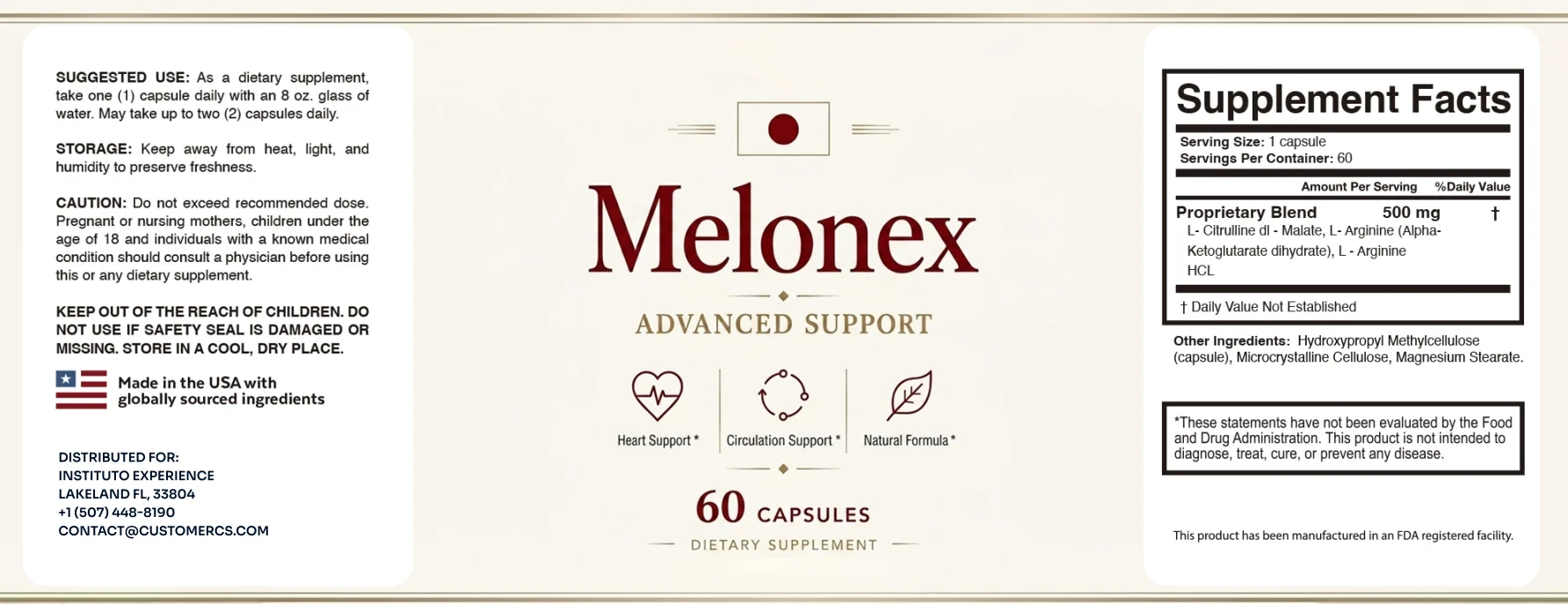
Melonex is a capsule with a 500 mg blend. Read the label first. It sits beside habits and never replaces your cuff or your medicine.

Prices listed on the seller's order page; confirm at checkout. The 2-bottle kit costs $158, with $9.99 shipping. Ask your doctor about your medicines first. 60-day money-back guarantee per the seller.
Melonex is not a treatment; it is a dietary supplement. Ask your doctor or pharmacist first if you take blood-pressure medicine, nitrates for chest pain, an erectile-dysfunction drug such as sildenafil or tadalafil, a potassium-sparing diuretic (amiloride, spironolactone, triamterene), a blood thinner, or diabetes medicine, or if you have had a recent heart attack. Arginine and citrulline can add to these. Keep taking prescribed medicine. See side effects and interactions.
06FAQ
Melonex questions people ask
Which arm should you use for home cuff readings?
Use the same arm each time, ideally the one that reads higher if your clinician has compared both. Support it on a table with the cuff at heart level on bare skin. Switching arms between readings can make your log look noisier than it is.
How often should a home cuff be checked for accuracy?
Mayo Clinic suggests bringing your monitor to a clinic visit once a year to compare it with office equipment. Do it sooner if readings look odd, the cuff is damaged or the tubing leaks. Bring your log along.
Is a wrist blood pressure monitor accurate enough?
The AHA does not recommend wrist or finger monitors. Position errors are easy to make, and the reading shifts with wrist height. A validated automatic upper-arm cuff is the safer choice for a home log.
Why is my second home reading different from the first?
The second reading is often lower because you have settled. That is why the AHA asks for two readings one minute apart. Write both down and let your clinician look at the average over several days.
07Who wrote this
Written and reviewed by
Pages built from the label, the seller's materials and linked NIH, FDA, CDC, AHA, FTC and peer-reviewed sources.
Last updated . Read how we write and how we check reviews. This website is run by Melonexheart, which describes itself as a U.S. authorized Melonex merchant. It is not the manufacturer or the label's distributor, and we cannot independently verify the 'authorized' status. We are paid when you buy through our order links.


+Keep reading
More about Melonex
U.S. authorized Melonex merchant
Ready to try Melonex?
Show the bottle to your doctor or pharmacist first, then pick a pack. Six bottles cost the least per bottle, and the seller lists a 60-day money-back guarantee on every pack.
- Secure checkout
- 60-day money-back
- Ships from the U.S.